Ear plug fitting is the process of correctly inserting hearing protection devices into the ear canal to achieve a complete acoustic seal, ensuring the wearer receives the full noise reduction rating (NRR) specified by the manufacturer under OSHA 29 CFR 1910.95 testing conditions.
The key takeaway: Real-world NRR depends entirely on fit and seal — 40% of workers get less than half their ear plugs' rated noise reduction due to incorrect insertion. The correct technique is Roll-Pull-Hold: roll foam into a tight cylinder, pull the ear upward to straighten the canal, and hold 20–30 seconds for full expansion. With proper fit, NRR 33 foam plugs deliver 13+ dB real-world reduction per OSHA's derating formula, versus as low as 5 dB with poor insertion. One prevented hearing loss claim ($50,000–$150,000) pays for a decade of fit testing.
How do you test the fit and seal of ear plugs before buying? Use the cupped-hands seal check: insert the plugs, then cup both palms tightly over your ears and release. If the noise level barely changes, the plugs are sealed correctly; if covering your ears makes it noticeably quieter, the seal is incomplete and you need a different size or insertion technique. Before committing to a bulk order, confirm the supplier offers more than one size and request a sample so workers can run this check themselves — ear-canal size varies, so a single universal plug rarely seals every worker.
Here is a fact that surprises most safety managers: according to research published by NIOSH, approximately 40% of workers wearing ear plugs in industrial settings receive less than half of the noise reduction rating (NRR) printed on the packaging. The reason is not defective products — it is improper insertion technique. Understanding how to fit ear plugs correctly is the single most cost-effective improvement you can make to your hearing conservation program.
The Real-World NRR Gap
Every pair of ear plugs comes with an NRR value tested under ideal laboratory conditions following ANSI S12.6. A foam ear plug rated NRR 33 should theoretically reduce noise exposure by 33 decibels. However, real-world performance tells a different story.
OSHA recognizes this gap and mandates a derating formula: subtract 7 from the NRR, then divide by 2. So a pair of NRR 33 ear plugs provides an estimated real-world reduction of only 13 dB — less than 40% of the lab rating. This derating exists precisely because most workers do not insert ear plugs correctly.
The consequences are serious. A worker in a 95 dB environment wearing NRR 33 plugs might assume they are protected down to 62 dB. In reality, with poor fit, their actual exposure could be 85 dB or higher — right at the OSHA action level where hearing damage begins. Compliance on paper but not in practice.
Roll-Pull-Hold: The Correct 3-Step Fitting Technique
The difference between 50% and 95% of rated NRR comes down to three simple steps performed correctly every time:
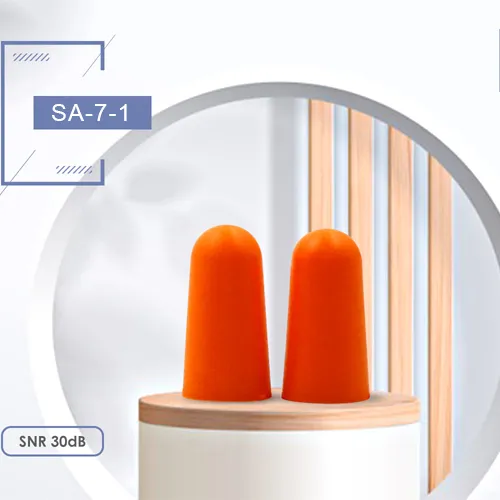
- Step 1 — Roll: Take the foam ear plug between your thumb and first two fingers. Roll it into the tightest, smoothest cylinder possible. There should be no creases or wrinkles. A loosely rolled plug will not compress enough to enter the ear canal fully. Our SA-7-1 Bullet Shape Foam Ear Plugs are engineered with slow-recovery PU foam that gives workers a full 10-second insertion window before expansion begins.
- Step 2 — Pull: With your opposite hand, reach over your head and pull the top of your ear upward and outward. This straightens the ear canal, which naturally curves in most adults. Skipping this step is the single most common fitting mistake — the plug sits in the outer ear rather than sealing deep in the canal.
- Step 3 — Hold: Insert the rolled plug deep into the ear canal and hold it in place with your fingertip for 20 to 30 seconds. The foam needs time to expand and conform to the unique shape of your ear canal. Releasing too early means the plug pushes itself partially out before a full seal forms.
Visual check: When fitted correctly, foam ear plugs should not be visible when looking at the wearer from the front. If you can see the end of the plug protruding from the ear, it is not inserted deeply enough.
Foam vs Silicone: Fitting Differences
The fitting technique varies significantly between foam and silicone ear plugs, and choosing the right type for your workforce depends on the environment and worker turnover:
| Factor | Foam Ear Plugs | Silicone / Flanged Ear Plugs |
|---|---|---|
| Fitting method | Roll-Pull-Hold (requires training) | Push-and-twist (more intuitive) |
| Typical NRR | 29–37 dB | 22–28 dB |
| Best for | High-noise (>95 dB), disposable use | Moderate noise (85–95 dB), reusable |
| Replacement | After every shift | Every 2–4 weeks with cleaning |
| Training time | 5 minutes with demonstration | 2 minutes |
For workplaces with high employee turnover, silicone flanged plugs may achieve better real-world protection despite lower NRR ratings, simply because they are harder to insert incorrectly. For environments exceeding 95 dB, foam plugs remain essential — but only if paired with proper fitting training.
Fit Testing Programs: The ROI for Safety Managers
While OSHA 29 CFR 1910.95 requires annual audiometric testing for workers exposed to 85+ dB, it does not yet mandate individual fit testing for ear plugs. However, the ANSI/ASA S12.71 standard provides a framework for quantitative fit testing, and leading companies are adopting it voluntarily.
The business case is straightforward. A single noise-induced hearing loss (NIHL) workers' compensation claim averages $50,000 to $150,000 in the United States. A fit testing system costs $3,000 to $5,000 and can test hundreds of workers per year. One prevented claim pays for a decade of testing.
Recommended program structure:
- Annual quantitative fit test for every noise-exposed worker
- Quarterly 5-minute refresher training (Roll-Pull-Hold demonstration)
- New-hire fit testing on Day 1 before entering noise zones
- Personal Attenuation Rating (PAR) documented per ANSI S12.71
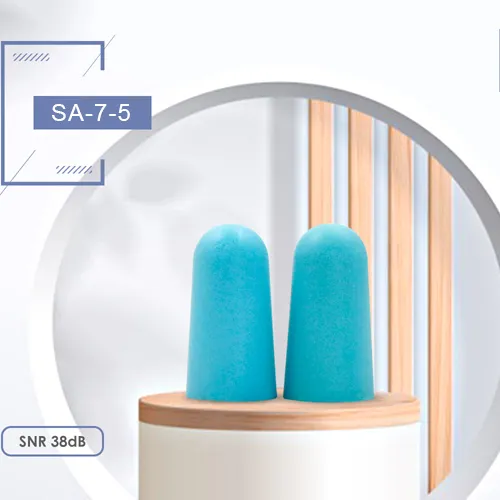
Workers who fail fit testing with foam plugs may perform better with a different plug size or type. Having multiple sizes available — such as our SA-7-5 Standard Bullet Shape alongside the smaller SA-7-1 — increases the probability of achieving a proper seal for all ear canal sizes.
Frequently Asked Questions
How do I know if my ear plugs fit correctly?
Perform the "cup test": after inserting both plugs, cup your hands firmly over your ears and release. If the noise level drops noticeably when you cup your hands, the plugs are not sealing properly and need to be reinserted. A well-fitted plug should make the cupping test produce minimal change in perceived sound. For definitive results, use a quantitative fit testing system that measures actual attenuation in decibels. See our SNR vs NRR ratings guide for detailed attenuation calculations.
Can I reuse disposable foam ear plugs?
No. Foam ear plugs are strictly single-use devices. After removal, the compressed foam structure does not fully recover to its original shape, reducing its ability to seal the ear canal on subsequent insertions. Additionally, earwax, moisture, and bacteria accumulate on the foam surface. Reusing foam plugs is a false economy — a pair costs less than $0.10, while compromised protection can lead to irreversible hearing damage worth thousands in medical costs and compensation claims.
What NRR rating do I need for a 95 dB environment?
Using the OSHA derating method (NRR minus 7, divided by 2), you need ear plugs with at least NRR 27 to reduce a 95 dB environment below the 85 dB action level. The calculation: (27 − 7) ÷ 2 = 10 dB effective reduction, bringing exposure to 85 dB. For an additional safety margin, choose NRR 32 or higher, which provides (32 − 7) ÷ 2 = 12.5 dB reduction, bringing exposure down to approximately 82.5 dB.
How often should ear plug fitting training be conducted?
Best practice is quarterly refresher training lasting 5 minutes per session, combined with an annual formal fit test. OSHA requires initial training for all workers in the hearing conservation program and annual retraining. However, studies show that fitting technique degrades over time without reinforcement. A quarterly schedule — aligned with safety committee meetings — maintains consistent protection levels throughout the year.
What is the OSHA derating formula for ear plugs?
The OSHA derating formula accounts for the gap between laboratory and real-world performance: subtract 7 from the NRR, then divide by 2. For example, NRR 33 ear plugs provide an estimated real-world reduction of (33 − 7) ÷ 2 = 13 dB. This conservative estimate assumes average worker fitting technique. Workers with proper Roll-Pull-Hold training consistently achieve higher real-world attenuation — up to 80–90% of the lab-rated NRR.
Why do foam ear plugs need to be rolled before insertion?
Foam ear plugs are made from slow-recovery polyurethane foam that must be compressed to a diameter small enough to enter the ear canal. Without rolling, the plug is too wide to reach the canal's narrowest point where acoustic sealing occurs. Once inserted, the compressed foam slowly expands over 20–30 seconds, conforming to the unique shape of the individual ear canal and creating a custom-fit seal. Skipping the rolling step or rolling loosely is the primary cause of the 40% NRR gap documented by NIOSH.
What is the difference between NRR and real-world noise reduction?
NRR (Noise Reduction Rating) is a laboratory measurement tested under ideal conditions per ANSI S12.6 standards, using trained subjects in soundproof chambers. Real-world noise reduction is the actual attenuation achieved by workers in factory and construction environments, which is typically 40–60% lower than the NRR due to improper fit, ear canal variation, and environmental factors. The OSHA derating formula bridges this gap by providing a conservative field estimate that safety managers can use for exposure calculations.
Need help improving your hearing protection program? Contact EASTRAGON for free ear plug samples, fit testing guidance, and OEM/ODM bulk pricing. We respond within 24 hours, with MOQ as low as 10,000 pairs for custom-branded hearing protection products.