You found a supplier, requested samples, and now a small box of ear plugs sits on your desk. What do you actually check before signing a purchase order for 50,000 pairs? Most procurement guides stop at "request samples and test them," without explaining what testing looks like in practice. This article fills that gap.
We have shipped hearing protection to buyers in over 50 countries since 2005. Along the way, we have seen orders go wrong because the buyer skipped one or two checks that would have taken fifteen minutes. The seven tests below do not require a laboratory. They require your hands, a stopwatch, a ruler, and some attention to detail.

Test 1: Foam Recovery Time
This is the single most revealing test for PU foam ear plugs, and it takes ten seconds. Roll the plug between your fingers into the tightest cylinder you can manage. Release it on a flat surface and start timing. A quality foam plug should begin expanding immediately and return to approximately 90% of its original shape within 45 to 60 seconds.
Why does this matter? Slow-recovery foam gives the user time to insert the plug before it expands. If it snaps back in under 20 seconds, most workers will struggle to get a proper seal. If it takes longer than 90 seconds, the foam is either too dense or the raw material quality is low, and it may never seal fully. Either extreme leads to real-world attenuation well below the labeled NRR.
Run this test on at least five plugs from different positions in the sample bag. Consistency matters as much as the individual result. If three plugs recover in 50 seconds and two take 80 seconds, the manufacturing process has a uniformity problem that will show up across a production run.
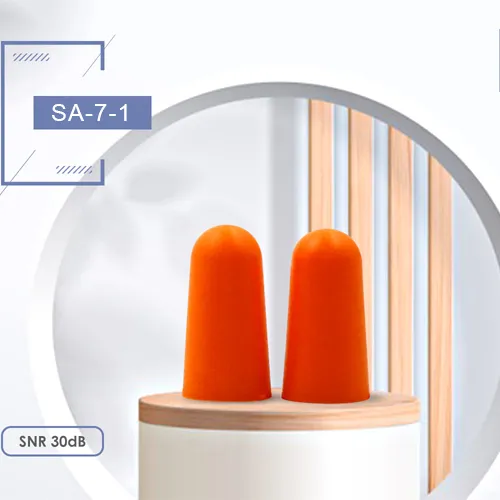
Our SA-7-1 PU foam ear plugs use a controlled slow-rebound formula that consistently hits the 45-55 second recovery window. When we evaluate our own raw material batches, foam recovery time is the first metric we check.
Test 2: Dimensional Consistency
Take ten plugs from the sample batch. Line them up on a flat surface. They should look identical. Measure the length and the widest diameter of each plug using a caliper or ruler. For a standard bullet-shape foam plug, expect length variation of no more than 1.5 mm across the batch. Diameter variation should stay within 1 mm.
Dimensional inconsistency is a manufacturing red flag. It suggests the die-cutting or molding process is not properly controlled. In foam plugs, size variation directly affects fit and attenuation. A plug that is 2 mm shorter than spec will not fill the ear canal properly. One that is 2 mm too wide will be uncomfortable and cause workers to remove it.
Check the surface finish while you are measuring. The foam should be smooth, without visible pores larger than 1 mm, without tears, and without discoloration. Yellow spots on white foam or uneven color on tinted foam indicate process issues such as incomplete mixing or temperature control failures during the foaming stage.
Test 3: Attenuation Verification
You cannot measure NRR or SNR without an acoustic laboratory, and you should not try. But you can verify that the sample matches the claimed certification. Here is how:
- Request the test report. Every certified ear plug has a test report from an accredited laboratory. For CE-marked products, this is a Notified Body (such as SGS, TUV, or Intertek). For ANSI-compliant products, the lab must be accredited per ISO 17025. Ask for the full report, not a summary or a certificate alone. The report should list attenuation values at each octave band frequency (125 Hz through 8000 Hz), not just the single NRR or SNR number.
- Match the report to the sample. Check that the product model, dimensions, and material description on the test report match what you are holding. Suppliers sometimes send test reports for a different SKU in the same product family.
- Check the test date. CE certification under Regulation 2016/425 requires type examination by a Notified Body. If the test report is older than five years, ask whether the certificate has been renewed. ANSI certification does not expire in the same way, but test data older than five years on a product that has been "updated" should raise questions.
A supplier who cannot produce the full laboratory test report within 48 hours of your request is a supplier you should not be ordering from. This documentation should be readily available, not something that needs to be "prepared."
Test 4: Skin Safety and Material Compliance
Ear plugs sit inside the ear canal for hours. The material must be biocompatible. For products entering the EU market, check for compliance with EN 352-2, which references biocompatibility requirements. For the US market, the relevant standard is ANSI/ASA S3.19 or S12.6.
Beyond formal certification, perform a simple practical test: wear a sample plug in each ear for two hours. Remove them and inspect your ear canals using a mirror or have a colleague check. Any redness, itching, or irritation within two hours is a deal-breaker. Foam ear plugs should feel like they are not there once properly inserted.
Ask the supplier for their raw material data sheet (MSDS or SDS). The polyurethane foam should be free of harmful plasticizers, latex, and PVC. If you are selling into markets with specific restrictions (REACH in Europe, Proposition 65 in California), confirm that the materials comply before ordering. Discovering a compliance gap after 50,000 pairs are on a container ship is expensive.
Test 5: Packaging Integrity
Packaging is easy to overlook during sample evaluation, but it causes a disproportionate share of quality complaints in the field. For individually wrapped disposable ear plugs, check these points:
- Seal integrity. Each pair should be sealed in a poly bag or blister pack. The seal must be airtight. Squeeze a sealed packet firmly. If air escapes, the seal will not protect the plugs from dust and moisture during storage and transport.
- Marking. Each individual package must show the manufacturer name, model number, NRR or SNR value, and lot number. For CE-marked products, the CE mark and Notified Body number are required on every individual package. Missing markings make the product non-compliant for sale, regardless of the actual quality.
- Carton quantity. Verify that the master carton count matches the quote. Standard packing for disposable foam plugs is 200 pairs per inner box, 10 inner boxes per master carton (2,000 pairs). Deviations are fine if agreed in advance, but discovering a different pack-out on arrival creates warehouse and distribution problems.
Test 6: Batch Consistency Check
This is where sample testing meets production reality. A supplier can send hand-picked samples that pass every test above. The question is whether 50,000 pairs from their production line will match. You cannot verify this before the first order, but you can take steps to protect yourself:
- Request samples from existing stock, not from a special production run. Tell the supplier you want plugs pulled from their current warehouse inventory, with the lot number visible. This gives you a realistic baseline of what their standard production looks like.
- Order from two lot numbers. If possible, request samples from two different production batches. Compare them side-by-side using the foam recovery, dimensional, and visual checks described above. If the two lots are noticeably different, the supplier has a process control issue.
- Include a quality clause in the purchase order. Specify that the delivered goods must match the approved sample in dimensions (within stated tolerances), foam recovery time (within a stated range), color, and packaging. This gives you contractual standing to reject non-conforming goods.
At EASTRAGON, we retain a sealed reference sample from every production batch. When a buyer raises a quality question, we pull the reference and compare. This is a standard practice at reputable manufacturers. Ask your supplier whether they do the same.
Test 7: Wear Test Under Real Conditions
The final test is the simplest and the one most often skipped. Give five or ten sample pairs to workers in your actual operating environment. Ask them to wear the plugs for a full shift. Collect feedback on three specific points:
- Comfort after four hours. Do the plugs cause pressure, itching, or ear fatigue? Comfortable plugs stay in. Uncomfortable plugs come out, and compliance drops.
- Perceived noise reduction. Workers cannot measure attenuation, but they can tell you whether the plugs feel effective. If experienced workers say the plugs "don't seem to do much" compared to their current brand, that feedback is worth investigating even if the NRR numbers look correct on paper.
- Insertion difficulty. Can workers roll and insert the plugs correctly on the first try? The insertion technique matters enormously for real-world attenuation. A plug that is difficult to insert will be inserted incorrectly by a percentage of your workforce, reducing effective protection across the board.
This wear test costs nothing and takes one day. It catches problems that no bench test will reveal, such as plugs that slip out of oily hands, foam that breaks down in humid environments, or cords that catch on machinery.
Summary: The 7-Point Quality Checklist
| Test | What to Check | Pass Criteria |
|---|---|---|
| 1. Foam Recovery | Time to return to shape after rolling | 45-60 seconds, consistent across 5+ plugs |
| 2. Dimensions | Length and diameter variation | Within 1.5 mm length, 1 mm diameter across 10 plugs |
| 3. Attenuation | Lab report matches sample, valid certification | Full report available within 48 hours, model matches |
| 4. Skin Safety | Material compliance, 2-hour wear test | No irritation, MSDS/SDS available, REACH/Prop 65 if applicable |
| 5. Packaging | Seal integrity, required markings, carton count | Airtight seals, CE/NRR on individual packs, correct count |
| 6. Batch Consistency | Samples from stock, compare 2 lot numbers | Consistent results between lots, reference sample retained |
| 7. Wear Test | Full-shift trial with real workers | Comfortable at 4 hours, effective, easy to insert |
What to Do When a Test Fails
Not every failed test means you should walk away from a supplier. The response to a failed test is often more informative than the failure itself. A supplier who acknowledges a dimensional inconsistency, explains the root cause, and offers to re-sample from a controlled batch is a supplier worth working with. A supplier who argues that the failure does not matter, or who sends the same samples again claiming they are "new," is telling you something about how they will handle problems during production.
Document every test result and share it with the supplier. Good manufacturers want this data because it helps them improve. If your feedback improves their process, you end up with a better product and a supplier who sees you as a serious partner rather than a one-time buyer.
Frequently Asked Questions
How many sample pairs do I need to run these tests?
Request at least 20 pairs. Use 10 for dimensional and recovery testing, 2 for the personal wear test, and distribute the rest to workers for the full-shift trial. If you are evaluating multiple suppliers, order 20 pairs from each to compare under identical conditions.
Can I test ear muffs using the same checklist?
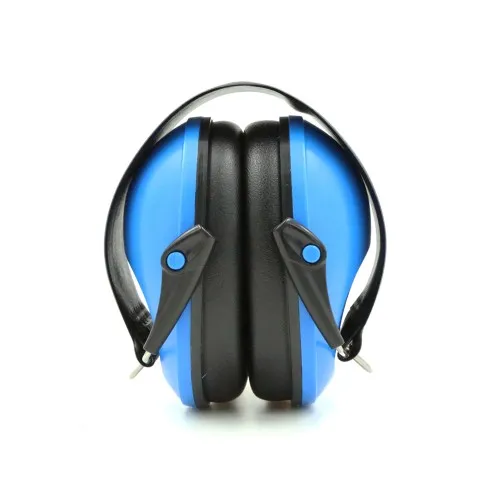
Tests 3 (attenuation verification), 4 (skin safety), 5 (packaging), 6 (batch consistency), and 7 (wear test) apply directly. Tests 1 and 2 are specific to foam plugs. For ear muffs, replace foam recovery with headband tension testing (the muffs should hold firmly without causing pressure headaches after one hour) and cushion compression recovery.
Should I hire a third-party inspector for my first bulk order?
Yes, for orders above 10,000 pairs from a new supplier. A pre-shipment inspection by an independent QC firm (SGS, Bureau Veritas, TUV, or a regional firm) costs $200-400 and covers random sampling against your approved reference sample. This is standard practice in China-origin PPE procurement and any reputable supplier will accommodate it without objection.
What is the most common quality problem with foam ear plugs from new suppliers?
Inconsistent foam density. The plugs look identical, but some are noticeably harder or softer than others within the same bag. This happens when the PU foam mixing or curing process is not tightly controlled. It directly affects both comfort and attenuation, because a plug that is too hard will not conform to the ear canal shape.
Ready to evaluate samples? Contact the EASTRAGON team for sample kits shipped within 3-5 business days. We include the full test report, MSDS, and certification documentation with every sample shipment. Browse our complete hearing protection catalog.