Every safety manager reaches a point where a simple specification decision becomes surprisingly complex: passive ear muffs or electronic? The two product categories both sit in the ear muff aisle, both carry CE or ANSI certifications, and both protect workers from noise-induced hearing loss. But they work on fundamentally different principles, carry very different price tags, and suit different workplace conditions. Choosing the wrong type at scale — across hundreds or thousands of workers — creates compliance gaps, budget overruns, or worker rejection that undermines the entire hearing conservation programme. This guide cuts through the marketing language and gives safety managers the data they need to specify the right product the first time.
Do passive ear muffs have a higher NRR than electronic? Usually yes — slightly. Top-tier passive ear muffs reach an NRR of 20–30 dB, while electronic ear muffs in passive mode typically rate 22–28 dB, because the added circuitry contributes no attenuation of its own. The 2–4 dB gap is the price electronic muffs pay for level-dependent pass-through, which lets workers hear speech and alarms during quiet intervals while still blocking harmful peaks. Choose passive for maximum raw protection and lowest cost; choose electronic when situational awareness is safety-critical.
What Are Passive Ear Muffs?
Industry definition: passive ear muffs are non-powered hearing protectors that attenuate noise purely through physical means, using two rigid foam-lined cups and a tensioned headband to seal sound out before it reaches the eardrum, with no microphones, batteries, or electronics involved.
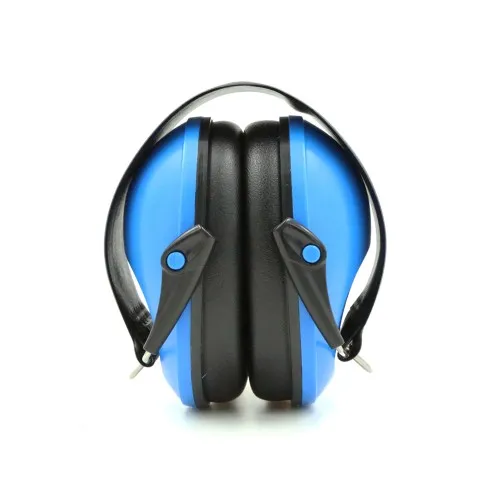
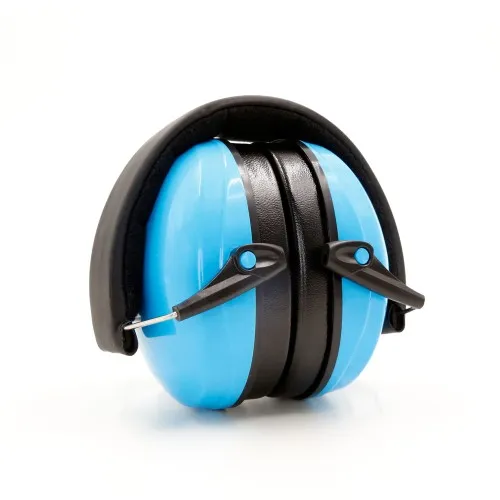
Passive ear muffs are the original and still-dominant technology in industrial hearing protection. They work by physically blocking sound waves before they reach the eardrum. A pair consists of two rigid plastic cups lined with acoustic foam or mineral wool, connected by a spring-tension headband that presses the cushioned seals against the sides of the head. No circuits, no batteries, no electronics — just mass, damping material, and a well-fitted seal.
The attenuation a passive ear muff delivers comes from three physical properties: the density of the cup shell, the thickness and composition of the internal acoustic foam, and the quality of the cushion seal. Most industrial-grade passive ear muffs achieve an NRR (Noise Reduction Rating, the US ANSI standard) of 20 to 30 dB, or an SNR (Single Number Rating, the European EN 352-1 standard) of 26 to 36 dB. For our full explanation of how NRR and SNR are calculated and how to apply them, see our NRR and SNR ratings guide.
Advantages of Passive Ear Muffs
- Highest raw attenuation available: A well-designed passive muff will consistently outperform an electronic model of the same price on peak NRR.
- No operating cost: No batteries, no charging infrastructure, no replacement electronics. The total cost of ownership over three years is predictable and low.
- No failure mode in the field: Passive muffs work on day one and day 1,000 identically. There is no risk of electronic failure, battery depletion mid-shift, or firmware issues.
- Easy to inspect and audit: Supervisors can visually confirm cup integrity, cushion condition, and headband tension. Compliance checks take seconds.
- Wide temperature tolerance: Passive muffs perform identically from −30 °C storage to +50 °C summer outdoor use. Electronics may degrade at temperature extremes.
Disadvantages of Passive Ear Muffs
- Blocks all sound equally: A passive muff attenuates warning signals, alarms, and colleague speech at the same rate as harmful machine noise. In environments where communication is safety-critical, this is a serious limitation.
- Reduced situational awareness: Workers may not hear forklift horns, overhead crane alerts, or supervisor instructions, creating secondary safety risks.
- Discomfort in prolonged wear: Cup weight and headband pressure accumulate over an 8-to-12-hour shift. Heat retention under the cups is an issue in warm environments.
What Are Electronic Ear Muffs?
Industry definition: electronic ear muffs are powered hearing protectors that use a microphone, amplifier, and speaker in each cup to deliver level-dependent attenuation, letting workers hear speech and warning signals during quiet intervals while automatically blocking sound peaks above roughly 82 dB.
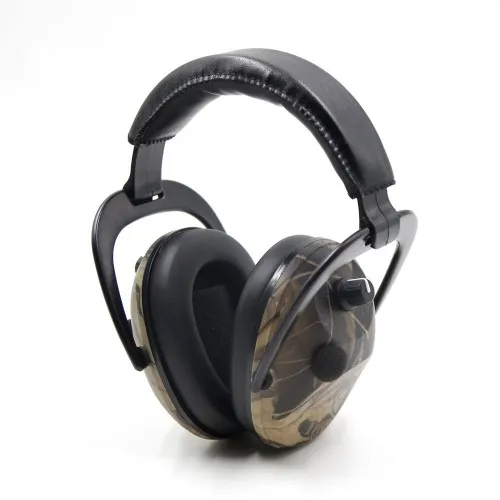
Electronic ear muffs use powered circuitry to actively manage the sound that reaches the wearer's ear. The cup construction is similar to a passive muff — rigid shells, acoustic foam, cushioned seals — but each cup also contains a microphone on the outside, an amplifier and signal processor inside, and a speaker that plays modified audio to the wearer's ear.
The core technology is called level-dependent attenuation (also called pass-through or ambient listening). At low ambient sound levels, the electronics amplify environmental sound so the wearer can hear speech and warning signals more clearly than they could without any protection. When the microphone detects a high-intensity sound event — typically anything above 82 dB — the circuit switches to pure passive attenuation within microseconds, blocking the harmful peak before it reaches the eardrum. The net result: workers hear each other normally during quiet intervals and receive full protection during loud events.
Premium electronic ear muffs also incorporate Bluetooth or radio connectivity for two-way communication, and some models include active noise cancellation (ANC) that electronically neutralises continuous low-frequency noise by generating an inverse waveform. NRR ratings for electronic ear muffs in passive mode typically range from 22 to 28 dB, slightly lower than top-tier passive models.
Advantages of Electronic Ear Muffs
- Maintained situational awareness: Workers hear warning alarms, speech, and ambient sounds normally during quiet periods. This is the defining advantage in environments with mixed noise profiles or vehicle traffic.
- Improved communication: Supervisors can give instructions and workers can respond without removing hearing protection. This directly reduces the temptation to take muffs off in noisy areas.
- Impulse noise protection: For environments with gunshot-level impulse noise (shooting ranges and military or police use, explosive demolition, nail guns), the microsecond response of electronic limiting is superior to passive attenuation for protecting against peaks — the same logic that drives military noise standards and TCAPS.
- Reduced noise-off events: Studies from the US NIOSH show that workers wearing level-dependent muffs remove them far less frequently than workers wearing passive muffs. Higher compliance time equals lower real-world dose.
Disadvantages of Electronic Ear Muffs
- Significantly higher unit cost: Entry-level electronic ear muffs start at two to four times the price of comparable passive models. Professional-grade units with Bluetooth run six to twelve times higher.
- Battery dependency: Most electronic ear muffs use two AAA batteries with a run time of 350 to 600 hours. A workforce of 200 workers changes batteries every two to three months — an ongoing consumable cost and a logistics task.
- Failure risk: Electronics can fail from moisture, impact, or component wear. A failed electronic muff may still provide passive attenuation, but the communication and limiting features are lost without immediate detection.
- Slightly lower maximum NRR: Electronic circuitry occupies space inside the cup, which limits the acoustic foam volume. For the absolute highest noise environments, a passive muff may deliver 2 to 5 dB more attenuation.
- Higher training burden: Workers need to understand battery management, volume controls, auto-shutoff features, and what to do when electronics fail. This adds complexity to the hearing protection programme.
Head-to-Head Comparison
| Specification | Passive Ear Muffs | Electronic Ear Muffs |
|---|---|---|
| Typical NRR range | 20–30 dB | 22–28 dB (passive mode) |
| Battery required | None | 2× AAA, 350–600 hr life |
| Unit weight | 200–400 g | 300–550 g |
| Unit cost (industrial grade) | USD 8–35 per pair | USD 35–180+ per pair |
| Speech communication | Severely reduced | Maintained at ambient levels |
| Warning signal audibility | Reduced or blocked | Preserved (level-dependent) |
| Impulse noise response | Passive damping only | Electronic limiting (<1 ms) |
| Failure modes | Cushion wear, cup crack | Battery, circuit, speaker failure |
| Best for | Continuous high-noise environments | Mixed-noise, communication-critical sites |
When to Choose Passive Ear Muffs
Before choosing between electronic and passive muffs, confirm that muffs rather than ear plugs are the right fit for the zone in the first place. Passive ear muffs remain the right specification in four common workplace scenarios:
1. Continuous, high-intensity machine noise above 100 dB. In metal stamping, die casting, textile manufacturing, and certain woodworking operations, workers are immersed in sustained loud noise for full shifts. Passive muffs with high NRR ratings provide the most robust protection in these settings. The inability to hear speech is often irrelevant because communication happens during breaks or via visual signalling systems.
2. Large, non-specialist workforces with high turnover. If your facility employs seasonal or temporary workers, passive muffs reduce programme complexity. There is nothing to charge, no settings to configure, and no batteries to track. Supervisors can hand out a pair and conduct a quick fit check without additional training. For a deeper look at how to structure hearing protection selection across mixed workforce types, see our industrial hearing protection guide.
3. Environments with strict contamination or moisture control. Electronics and high humidity or airborne particles are a risky combination. In food processing, certain chemical manufacturing, and outdoor construction in wet climates, passive muffs with no electronic components are inherently more reliable. They can typically be wiped down or replaced without concern for water ingress damage.
4. Budget-constrained programmes requiring maximum coverage. When the priority is equipping the largest possible number of workers to a compliant protection level, passive muffs deliver the most protection per procurement dollar. The difference in unit cost between a high-NRR passive muff and an entry-level electronic model can fund 2 to 4 additional pairs, which often matters more for programme outcomes than the technology type.
When to Choose Electronic Ear Muffs
Electronic ear muffs are the correct specification when communication or situational awareness is as important as noise attenuation:
1. Environments with mixed noise profiles and vehicle or equipment traffic. In warehousing and logistics, open-pit mining, oil and gas operations, agriculture and farming, and port operations, workers move between zones of different noise intensity. They need to hear reversing alarms, crane signals, and traffic warnings clearly, but also need protection when heavy machinery is active. Level-dependent electronic muffs are designed precisely for this use case — and a worker who removes a passive muff to communicate is unprotected. The electronic muff's compliance advantage often outweighs its lower peak NRR.
2. Supervisory and inspection roles. Safety inspectors, quality auditors, and team leaders moving across a facility need to communicate throughout their shifts without removing hearing protection each time. Electronic muffs allow them to maintain conversations in moderate-noise zones while staying protected as they move into louder areas. This is also relevant for maintenance technicians who must diagnose equipment faults by listening to sounds while in noisy environments.
3. Impulse-noise-dominant environments. At shooting ranges, in explosive demolition, and in heavy press shops with sharp impact peaks, the microsecond electronic limiting of a good electronic ear muff is genuinely superior to passive damping for peak pressure events. The passive foam in a traditional muff is slower to respond to a sudden impulse than an electronic circuit. For environments where the primary hazard is impulsive rather than continuous, electronic limiting delivers better real-world protection even if the static NRR number is comparable.
4. Environments with hearing-critical tasks. Some operators must listen for abnormal equipment sounds — bearing noise, valve leaks, compressor irregularities — while working in areas that require hearing protection for other noise sources. An electronic muff that amplifies low-level ambient sound while blocking peaks allows these workers to do their jobs safely and effectively. Passive muffs would force a choice between protection and task performance.
Cost Analysis for Bulk Procurement
Safety managers making the passive vs electronic decision at scale must look beyond unit cost. A true total cost of ownership (TCO) comparison over a 36-month programme period includes acquisition cost, battery consumables, replacement parts, and the cost of compliance failures from worn-out or rejected equipment.
Consider a hypothetical programme of 250 workers over 36 months, with a 15% annual replacement rate for worn or lost muffs:
| Cost Category | Passive Ear Muffs | Electronic Ear Muffs (Entry) |
|---|---|---|
| Initial unit cost (250 pairs) | USD 4,375 (@ USD 17.50/pair avg) | USD 17,500 (@ USD 70/pair avg) |
| Annual replacement (15% = 37 pairs) | USD 648/yr → USD 1,944 over 3 yr | USD 2,590/yr → USD 7,770 over 3 yr |
| Battery cost (2 AAA per 500 hr) | USD 0 | ~USD 1,800 over 3 yr (250 workers × 2 changes/yr) |
| 3-year TCO | ~USD 6,300 | ~USD 27,100 |
This example shows a 4.3× TCO premium for electronic over passive at entry-level price points. The premium narrows if workers reject passive muffs and compliance-related costs — additional training, incident investigations, medical monitoring — are factored in. The TCO difference widens significantly if you specify mid-range or professional electronic units.
The practical guidance for budget planning: if communication and situational awareness are genuine safety requirements (not preferences), the cost of electronic muffs is justified and should be built into the PPE budget. If the communication benefit is "nice to have" rather than safety-critical, the TCO difference is difficult to justify in a programme of this scale.
How to Specify Ear Muffs for Your Workforce
A structured specification process prevents the most common procurement errors — over-specifying expensive electronics for simple continuous-noise applications, or under-specifying passive muffs where communication is genuinely safety-critical.
- Step 1 — Conduct a noise survey: Use a calibrated sound level meter or hire an occupational hygienist to measure noise levels at each workstation. Identify whether noise is continuous, intermittent, or impulsive. Without measured data, specification is guesswork. See our CE vs ANSI certification guide to understand how test standards translate to real-world performance.
- Step 2 — Map communication requirements: Interview supervisors and workers to identify which roles require voice communication or must respond to auditory warning signals during noise exposure. These roles are candidates for electronic muffs. Roles in isolated continuous-noise positions rarely need electronic capability.
- Step 3 — Check PPE compatibility: Ear muffs must work alongside hard hats, safety spectacles, and respirators. Confirm that the muff cup and headband design is compatible with your existing PPE inventory. Some hard hats include dedicated muff attachment slots that require specific muff models.
- Step 4 — Request samples and run a site trial: Specify a minimum 2-week site trial with 10 to 20 workers wearing the candidate product in actual working conditions. Collect feedback on comfort, communication, and compliance. A product that workers reject in trial will fail in programme-scale deployment.
- Step 5 — Verify certification documents: Request the full CE EN 352-1 (passive) or EN 352-6 (electronic) test report, not just the certificate. Confirm that the test was performed by an accredited notified body. For ANSI markets, request the ANSI S3.19 or S12.42 test data.
- Step 6 — Confirm supply chain reliability: For programmes of 100+ workers, confirm your supplier's production capacity, lead time, and stock availability. A hearing protection programme fails if replacement stock is unavailable mid-year.
OEM/ODM Options for Distributors
Safety equipment distributors, regional wholesalers, and industrial supply companies frequently find that stocking a private-label or branded ear muff line provides margin advantages over reselling standard commodity products. EASTRAGON's manufacturing facility produces both passive and electronic ear muff models under OEM and ODM arrangements, with options including custom headband colours, branded cup printing, custom NRR ratings within certified ranges, and private-label packaging.
For distributors looking to differentiate in crowded markets, a branded ear muff programme built on a proven manufacturing base offers the product quality and certification compliance buyers demand without the capital investment of building manufacturing capability. Our electronic ear muff line, including active noise isolation models, is available for OEM programmes with minimum order quantities suited to regional distribution volumes.
For a detailed explanation of how OEM and ODM arrangements work for PPE products and what questions to ask your manufacturing partner, see our OEM vs ODM guide.
Frequently Asked Questions
Can electronic ear muffs provide the same NRR as passive ear muffs?
In most cases, no. Electronic ear muffs use internal space for microphones, amplifiers, speakers, and batteries, which limits the acoustic foam volume compared to a purely passive design. As a result, top-tier passive ear muffs typically achieve NRR 28–30 dB while comparable electronic models reach NRR 22–26 dB in passive mode. The gap is generally 2–5 dB, which matters in environments at or above 105 dB TWA but is inconsequential for most standard industrial applications below 100 dB. If your primary requirement is maximum attenuation in a very loud environment, a passive muff will outperform an electronic one at equivalent price points.
How often do batteries need to be replaced in electronic ear muffs?
Most industrial electronic ear muffs use two AAA alkaline batteries with a rated run time of 350 to 600 hours of continuous use. For a worker logging 8 hours per day, 5 days per week, this equates to roughly 9 to 15 weeks between battery changes, or approximately 3 to 6 battery changes per year. Many models include an auto-shutoff feature that extends battery life by cutting power when the muff is stored. For a workforce of 100 workers, budget for approximately 300 to 600 AAA batteries per year and establish a clear battery replacement protocol, since failed batteries are the most common reason workers remove electronic muffs and do not replace them promptly.
Are electronic ear muffs required for environments with vehicle traffic?
Many safety standards and risk assessment frameworks recommend electronic or level-dependent hearing protection in environments where workers must respond to auditory warning signals such as vehicle reversing alarms, emergency horns, and overhead crane bells while in hearing protection zones. Passive ear muffs can reduce the audibility of these signals to the point where they are missed, creating a secondary collision or crush hazard. Whether a regulation specifically requires electronic muffs depends on your jurisdiction and industry sector, but the practical risk argument for electronic muffs in mixed vehicle-and-pedestrian environments is strong. Consult your occupational hygienist and review the relevant sections of ISO 9612 or OSHA 1910.95 for your specific context.
What is the typical service life of passive versus electronic ear muffs?
Passive ear muffs in regular industrial use typically need cushion replacement every 6 to 12 months as the foam compresses and loses sealing effectiveness, while the cup and headband assembly can last 2 to 5 years with proper care. Electronic ear muffs share the same cushion replacement timeline but introduce electronics as an additional wear item, with microphones and speakers typically lasting 2 to 4 years under industrial conditions. For both types, the practical replacement trigger should be degraded cushion condition or failed performance, not a fixed calendar schedule. Establish a quarterly inspection programme in which supervisors check cushion integrity, cup condition, and headband tension for every muff in the programme.
Can passive and electronic ear muffs be mixed within the same facility?
Yes, and this is often the most cost-effective approach. Many industrial facilities specify passive ear muffs as the standard issue for workers in fixed, high-noise stations and reserve electronic models for supervisors, maintenance technicians, and workers in mixed-noise zones where communication is safety-critical. This tiered approach means you capture the compliance and communication advantages of electronic technology where they matter most, while keeping programme costs manageable for the majority of the workforce. The key is to document clearly which roles receive which product type and why, so that the rationale is defensible in a safety audit and workers understand the programme logic.
How much do electronic ear muffs cost compared to passive ear muffs?
Passive industrial ear muffs typically run $8 to $25 per pair at distributor volumes, while electronic level-dependent models start at $40 to $80 and professional Bluetooth-enabled units reach $120 to $250 per pair. The rule of thumb is electronic muffs cost three to ten times a comparable passive pair. Over a three-year horizon, factor in battery consumables of roughly $4 to $8 per worker per year for electronic models. For a 200-worker programme, the realistic budget difference is significant, which is why most facilities reserve electronic muffs for the roles where situational awareness is genuinely safety-critical rather than issuing them site-wide.
At EASTRAGON, we manufacture both passive and electronic ear muff ranges certified to CE EN 352-1 and EN 352-6, with OEM/ODM capabilities for custom branding and specification. Our SA-8-5 Durable Soundproof Foldable Earmuffs and SA-8-10 Apple Shape Adult Size Earmuffs represent our passive range, while the SA-9-2 Electronic Active Noise Isolation Ear Muffs deliver level-dependent electronic protection for communication-critical environments. Contact our team for samples, certification documents, and a bulk procurement quote within 24 hours.